Why Softwashing Training Matters
Softwashing training matters because low-pressure cleaning still involves high-consequence decisions. Choosing the wrong chemical, misidentifying a surface or overlooking a drain can cause damage, expose people to hazardous substances and turn a straightforward job into an expensive claim.
Good training teaches you to assess the surface, select an appropriate treatment, control exposure and run-off, operate equipment correctly and recognise when not to proceed. It also helps contractors quote accurately and explain realistic results to customers.
For UK exterior cleaning contractors, property maintenance teams, facilities managers and serious DIY users, the benefit is not simply learning how to spray a product. It is learning how to make safe, repeatable decisions before, during and after treatment.
What Is Softwashing Training?
Softwashing training is structured instruction in cleaning exterior surfaces using suitable chemical treatments and controlled, low-pressure application. It should cover surface identification, contamination, chemical selection, equipment, risk assessment, environmental protection and practical application.
Softwashing is commonly used to manage algae and other biological growth on suitable render, masonry and roof coverings. However, it is not one universal chemical mixture or a method suitable for every building material.
Pressure, chemistry, dwell time and any subsequent rinsing must be appropriate to the surface and the product instructions. A sound course explains how these factors interact rather than offering a single recipe for every job.
Why Low Pressure Does Not Mean Low Risk
Reducing application pressure can reduce the risk of mechanical damage compared with inappropriate high-pressure washing. It does not remove chemical, environmental or access hazards.
A low-pressure spray can still drift onto vehicles, affect planted areas or enter an open window. Treatment can also expose defects that were previously hidden beneath biological growth.
Consider a rendered wall above an entrance. The cleaning challenge is not just removing green growth. You must also consider people passing below, ventilation openings, nearby metalwork, surface condition and where any liquid will travel.
Training helps operators see the whole work area, not just the dirty surface.
What Good Softwashing Training Should Teach
1. Surface Identification and Condition Assessment
Render, natural stone, concrete, painted masonry, timber and roof tiles do not respond in the same way. Even apparently similar surfaces may have different coatings, finishes or underlying defects.
A useful pre-clean inspection should identify:
- The likely substrate and any applied coating.
- Cracks, loose material, failed pointing or damaged seals.
- Previous repairs and differences in absorbency.
- Water-entry points, vents and electrical fittings.
- Sensitive adjacent materials, including metals, glass and vegetation.
For example, a patch of pale staining on render may be a previous repair, not contamination. Continuing to apply cleaner will not make two different finishes match.
Training should also explain test patches. These help assess compatibility and likely results, but they do not guarantee that a large, varied elevation will behave uniformly. Inspect the test area after the appropriate treatment period and, where relevant, once dry.
2. Identifying What Actually Needs Removing
Green algae, dark biological staining, rust marks, oil contamination and mineral deposits require different approaches. Treating every mark as organic growth wastes chemical and can damage the substrate.
A trained operator distinguishes contamination from discolouration caused by weathering, material differences or defects. They also recognise when specialist investigation is needed.
This improves customer communication. You can explain which marks should respond to treatment, which may need a separate process and which are unlikely to disappear through cleaning alone.
3. Chemical Selection and Safe Handling
Training should teach operators to use the current product label, technical instructions and safety data sheet together. They serve different purposes: an SDS describes hazards and handling precautions, while the label and technical instructions define permitted uses and application requirements.
Important learning points include:
- Checking that the product is suitable for the intended surface and task.
- Following stated dilution, application, dwell-time and rinsing instructions.
- Understanding exposure routes and selecting suitable protective equipment.
- Planning storage, transport, spill response and first aid.
- Recognising incompatible substances and keeping them separated.
Never mix cleaning chemicals unless the manufacturer expressly specifies that combination. In particular, mixing hypochlorite products with acids or ammonia can release dangerous gases. Do not assume an additive is compatible because it is sold for exterior cleaning.
Where a product is used as a biocide, check its applicable regulatory status and permitted use. Requirements can differ between Great Britain and Northern Ireland, so verify the current requirements for your location and the particular product.
4. Equipment Set-up and Application Control
A reliable application system is more than a pump and a hose. Operators need to understand chemical compatibility, output, dosing accuracy, nozzle selection, maintenance and shutdown procedures.
Small faults matter. A leaking connector can expose an operator or contaminate a customer's driveway. An unsuitable nozzle can increase drift, while an incorrectly configured injector can produce a different application concentration from the one intended.
Before choosing professional softwashing equipment, establish the intended tasks, required access and compatibility with the products you plan to use. Training helps you make those decisions rather than buying on pump output alone.
How Training Changes Everyday Decisions
| Situation | Untrained assumption | Better-informed approach |
|---|---|---|
| Dark marks remain after treatment | Apply a stronger solution immediately. | Reassess the staining, surface condition and expected treatment timescale. |
| A wall is close to a surface-water drain | Dilution will make the run-off acceptable. | Identify drainage routes and establish lawful containment, collection or disposal arrangements before starting. |
| Wind increases during application | Finish quickly before conditions worsen. | Stop and reassess drift, exposure and whether work can continue safely. |
| A roof has heavy moss and fragile coverings | Spraying from a ladder will be sufficient. | Assess roof condition, debris management and safe access; decline or refer work beyond your competence. |
| A customer wants a guaranteed permanent result | Promise that treatment will prevent regrowth. | Explain realistic results and how shade, moisture and surrounding vegetation influence recurrence. |
Training, COSHH and UK Safety Responsibilities
Professional training supports compliance, but a course certificate does not replace your legal duties or prove competence for every task.
Depending on the work, relevant requirements may include the Control of Substances Hazardous to Health Regulations, work-at-height legislation, equipment safety duties and environmental controls. Northern Ireland has its own corresponding legislation in several areas.
Risk Assessments Must Reflect the Actual Site
A general risk assessment provides a starting point. It will not tell you that a particular property has an open pond beneath the work area, a nursery next door or a damaged gutter discharging onto a public footpath.
A site-specific assessment should consider who could be harmed, how exposure or damage could occur, the controls required and what would trigger a stop-work decision. The Knowledge Centre guide to a softwash risk assessment explains why this is central to professional practice.
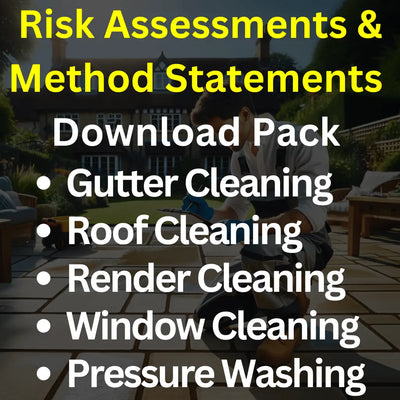
Written procedures also need to be usable. The RAMS Pack for Exterior Cleaning can support documentation, but templates must be adapted to your products, equipment, workforce and site. Purchasing paperwork is not the same as implementing controls.
COSHH Is More Than Keeping an SDS
A COSHH assessment considers how a hazardous substance is actually used: the amount, application method, exposure duration, people affected and control measures. An SDS informs that assessment; it is not the assessment itself.
Controls should prioritise preventing or reducing exposure. PPE is part of the system, not a substitute for suitable application methods, exclusion zones and sound work planning. Where tight-fitting respiratory protective equipment is required, appropriate selection and face-fit testing are important.
Run-off Needs a Plan Before Application
Identify surface-water drains, foul drainage, watercourses, soakaways and sensitive ground. Do not assume that a drain can lawfully receive wash water because it is nearby.
Requirements depend on the discharge and local arrangements. Collection, containment or an agreed disposal route may be necessary. Pre-wetting plants or diluting residues is not a substitute for pollution prevention, and discharge to a foul sewer may require consent.
A Practical Workflow Training Should Help You Follow
- Survey the site. Identify the surface, contamination, defects, access constraints, occupants, neighbouring property and drainage.
- Define the result. Agree the cleaning scope, likely limitations and whether improvement will be immediate or develop over time.
- Select the method. Check product suitability and instructions, consider alternatives and complete an appropriate test patch.
- Prepare the controls. Complete risk and COSHH assessments, establish exclusion arrangements, protect sensitive areas and organise run-off management.
- Check equipment and conditions. Inspect hoses, fittings, dosing arrangements and emergency supplies. Reassess weather and access before application.
- Apply and monitor. Follow the product instructions, watch for drift or unexpected reactions and stop if conditions move outside your safe working plan.
- Complete and document. Carry out any specified rinsing, manage residues, inspect the result, record observations and give suitable aftercare advice.
On occupied commercial premises, coordinate the work with the facilities manager. Delivery times, fresh-air intakes, pedestrian routes and emergency exits can all affect when and how treatment should take place.
Why Training Matters Commercially
More Accurate Quotes
Surface area is only one part of a quote. Access, protection, drainage controls, preparation, chemical demand and return visits can change the cost substantially.
Two walls of the same size may require very different resources. One may be accessible from a private courtyard; the other may overlook parked cars and a busy entrance. Training helps contractors price the actual method rather than simply applying a square-metre rate.
Clearer Customer Expectations
Professional communication separates cleaning from repair and avoids unrealistic promises. Record pre-existing defects, agree any exclusions and explain why a staged result or follow-up assessment may be appropriate.
Good records also help when a customer later asks whether a crack, faded coating or loose fitting was present before work began.
Better Insurance Conversations
Do not assume a general cleaning policy covers chemical treatment, roof cleaning or work at every height. Explain your actual activities to your insurer or broker and check relevant exclusions and conditions.
Training records can support that conversation, but they do not guarantee cover. Read the guidance on softwash contractor insurance alongside your own policy documents.
How to Choose a Softwashing Training Course
Look beyond the certificate and ask what you will be able to assess or do differently afterwards.
- Relevant content: surface assessment, chemistry, equipment, application, environmental controls and business practice.
- Clear safety boundaries: including when to stop, seek advice or refer work.
- Meaningful assessment: opportunities to check understanding rather than simply watch material.
- Practical relevance: explanations of site decisions, troubleshooting and equipment limitations.
- Accessible support: resources you can revisit as your work develops.
Online learning can build a strong foundation and provide useful refresher material. Practical competence still requires suitable equipment familiarisation and, where needed, supervised practice and task-specific instruction.
If you are comparing credentials, understand what CPD certified softwash training means. CPD certification is not a statutory licence and should not be presented as blanket permission to undertake every exterior cleaning task.
To explore the teaching before committing, you can try selected lessons from the SoftWash UK course for free. The preview offers a low-pressure way to assess the course structure and approach before deciding whether the full programme suits your needs.
Common Myths About Softwashing Training
“I Already Pressure Wash, So I Do Not Need Additional Training”
Existing cleaning experience is valuable, but chemical compatibility, exposure controls and biocide use introduce different considerations. Skills transfer; competence should not simply be assumed.
“Stronger Chemical Means Better Cleaning”
Increasing concentration without justification can increase risk without solving the problem. Incorrect diagnosis, unsuitable conditions or a non-removable stain may be the real issue. Follow the product instructions rather than improvising stronger treatments.
“One Course Means I Am Trained for Life”
Products, equipment, guidance and the jobs you accept can change. Review near misses, revisit procedures and refresh knowledge when introducing new work. Resources such as the SoftWash UK Podcast can support ongoing learning, but do not replace product instructions or task-specific training.
Frequently Asked Questions
Is Softwashing Training a Legal Requirement in the UK?
There is no single universal softwashing licence. However, employers and self-employed contractors have duties to work safely, and employers must provide appropriate information, instruction, training and supervision. Particular products, equipment or activities may carry additional requirements. Check what applies to your work.
Can I Learn Softwashing Entirely from Online Videos?
Videos can explain useful principles, but isolated demonstrations may omit surface condition, product restrictions and site controls. Structured learning, equipment familiarisation and appropriate practical experience provide a stronger basis for safe decisions.
Does a Facilities Manager Need Training If a Contractor Does the Cleaning?
A facilities manager may not need operator-level training, but understanding the process helps them specify work, review RAMS, coordinate occupants and assess contractor competence. A certificate alone is not enough evidence of suitability.
Is Training Worthwhile for Serious DIY Users?
Yes. Domestic work still presents risks to people, pets, plants and property. Learning the limits of the method is particularly useful. Professional-use-only products and tasks involving hazardous access may be unsuitable for DIY work.
Will Training Prevent Every Problem?
No. Buildings and site conditions vary. Training reduces avoidable mistakes and improves your response to unexpected findings, but it cannot replace inspection, judgement, maintenance or the decision to stop when necessary.
Build Competence Before Expanding Your Service
Softwashing training matters because professional results depend on assessment and control, not simply application. The strongest operators know what they are treating, why their method is appropriate and what would make them stop.
SoftWash UK supplies professional softwashing chemicals, equipment and training, supported by educational resources. If you want a more structured foundation for your work, explore the SoftWash UK softwashing training course and assess how it fits your experience and intended services.
Invest in understanding before taking on more demanding jobs. Better decisions protect people, property and the reputation your business depends on.