How Professional Training Can Reduce Costly Errors in Exterior Cleaning
Professional training reduces costly exterior cleaning errors by helping you identify surfaces correctly, select suitable cleaning methods, control chemical application and price work realistically. It also teaches you when to stop, reassess or decline a job before a manageable problem becomes property damage, an injury or an insurance claim.
For UK exterior cleaning contractors, property maintenance teams and facilities managers, these decisions directly affect profitability. A job that looks straightforward from the pavement can involve fragile render, defective pointing, sensitive metalwork, restricted drainage or difficult public access.
Serious DIY users face many of the same technical risks, without necessarily having professional equipment or insurance cover. Understanding your limits is just as important as understanding how a cleaning system works.
Good softwashing training is therefore not simply about learning to apply a product. It is about building a repeatable decision-making process that protects people, property and your margin.
Where Do Costly Exterior Cleaning Mistakes Start?
Most expensive mistakes begin before cleaning starts: an incomplete survey, an incorrect assumption about a stain, an unsuitable quotation or a failure to check where wastewater will go.
The immediate cost may be obvious, such as replacing damaged equipment. Other losses are less visible: unpaid return visits, excessive chemical use, additional access hire and time spent resolving complaints.
| Common error | Potential consequence | What training should improve |
|---|---|---|
| Misidentifying the surface or coating | Discolouration, coating failure or surface erosion | Surveying, compatibility checks and test-area assessment |
| Treating every stain as organic growth | Ineffective treatment and unnecessary chemical use | Stain identification and realistic treatment selection |
| Using an unsuitable application rate | Poor results, excessive runoff or avoidable exposure | Calibration, label interpretation and controlled application |
| Ignoring access and drainage | Unsafe work, pollution risk or unplanned equipment hire | Site planning and method selection |
| Quoting only for cleaning time | Lost margin and pressure to rush | Full job costing and clear scope definition |
| Failing to record existing defects | Disputes over cracks, leaks or failed finishes | Pre-work photographs and customer communication |
1. Training Helps You Choose the Right Cleaning Method
Identify the substrate before choosing the treatment
Render, natural stone, concrete, painted timber and coated cladding do not respond in the same way. Even two rendered walls can require different approaches because their finishes, condition and manufacturers’ requirements differ.
Low pressure alone does not make a method safe. Chemical compatibility, contact time, application volume and existing defects matter too.
Consider a rendered elevation with dark staining below a leaking gutter. Cleaning may improve the appearance, but it will not repair the leak. If the finish is already lifting, treatment may reveal or worsen an existing weakness. A competent survey separates the cleaning task from repairs that should happen first.
Distinguish biological growth from other staining
Algae and some other biological growth may respond to an appropriate softwashing treatment. Rust, oil, mineral deposits and staining associated with metal runoff need different investigation and potentially different treatment.
Repeatedly applying a biocide to a non-biological stain wastes material and increases exposure without addressing the cause.
Professional judgement includes recognising uncertainty. Where the substrate, coating or stain cannot be identified confidently, seek manufacturer guidance or specialist advice rather than experimenting on the full elevation.
2. Chemical Training Reduces Waste and Damage
Understand the label, not just the product name
A familiar chemical name is not a complete application specification. Product concentration, formulation, permitted uses and instructions can differ.
Before use, check:
- Whether the product is suitable for the intended surface and task.
- The label instructions, including any dilution and application requirements.
- The safety data sheet and the controls identified by your COSHH assessment.
- Requirements for personal protective equipment, storage and emergency arrangements.
- Restrictions relating to weather, nearby vegetation, drainage and public access.
Where a product is used as a biocide, check its lawful status for the intended UK use and follow its label. Requirements can differ between Great Britain and Northern Ireland. Never assume that a product available to buy is suitable for every exterior cleaning application.
Never mix cleaning chemicals unless the manufacturer explicitly instructs it. In particular, mixing hypochlorite with acids can release toxic chlorine gas. Dedicated, clearly labelled containers and suitable flushing procedures help prevent accidental cross-contamination.
Practise dilution calculations and equipment calibration
Confusing concentrate strength with working-solution strength is a common source of error. So is assuming that an injector setting automatically produces the intended dilution at the nozzle.
Actual delivery can be affected by the equipment configuration, operating conditions and component condition. Training should teach operators to verify performance against the manufacturer’s procedure rather than relying on a dial position.
When selecting professional softwashing equipment, look beyond headline output. Chemical compatibility, pressure limits, maintenance requirements and controllable delivery are often more important than speed alone.
More chemical is not automatically more effective. Correct identification, suitable conditions and controlled coverage usually provide a better basis for consistent results than increasing concentration to compensate for poor planning.
3. Safety Training Prevents Expensive Shortcuts
An injury or pollution incident can outweigh the income from many successful jobs. Training should help you remove hazards where possible and control the risks that remain.
Make risk assessments specific to the site
A domestic driveway beside an open garden is different from a shopfront beside a busy pavement. The product may be the same, but pedestrian management, overspray controls and working hours may need to change.
A useful assessment considers:
- Employees, customers, residents, visitors and passing members of the public.
- Chemical exposure, spray drift, slips and hose trip hazards.
- Electrical equipment, fragile surfaces and access restrictions.
- Plants, ponds, watercourses and drainage routes.
- Weather conditions and clear reasons to stop work.
The SoftWash UK Knowledge Centre guide to softwash risk assessment explains why this process belongs before mobilisation, not after a problem occurs.
Plan access and runoff before starting
Work at height should be avoided where reasonably practicable. Where it cannot be avoided, access arrangements must be properly planned, supervised and carried out by competent people using suitable equipment. A softwashing certificate alone does not establish competence for roof access or operating a MEWP.
Wastewater also needs a planned route. Do not assume a drain leads to a foul sewer or that contaminated wash water can be discharged into it. Identify the drainage system and establish suitable containment, disposal arrangements and any required permissions before work starts.
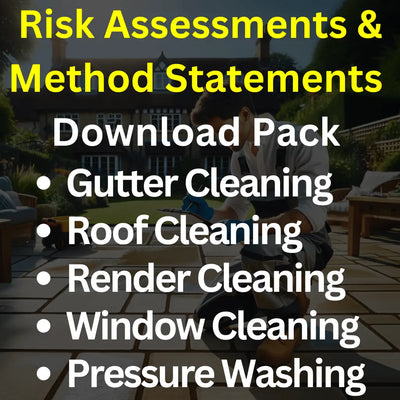
A RAMS pack for exterior cleaning can help structure documentation. However, templates must be adapted to the actual site, products and activities; they do not replace assessment or competence.
4. Better Training Improves Quoting and Profitability
Underquoting is often a technical knowledge problem disguised as a pricing problem. If you do not recognise the work involved, you cannot reliably price it.
A realistic quotation should allow for:
- Surveying, testing and preparation.
- Access equipment and delivery costs.
- Chemicals, water and consumables.
- Protection of neighbouring surfaces and landscaping.
- Public segregation, runoff control and waste handling.
- Cleaning, rinsing and final inspection where required.
- Administration, travel and agreed follow-up work.
Define what the customer is buying
“Clean the roof” is an ambiguous scope. Does it include moss removal, treatment, gutter clearance, waste removal and photographs? How will delicate areas be accessed? Are there defects that must be repaired first?
Training should help contractors explain these details without promising an unrealistic result. Some treatments act progressively, and some discolouration may remain because it is not removable biological growth.
Facilities managers can use the same principles when assessing quotations. Compare proposed methods, exclusions and risk controls, not just the total price.
Check insurance before accepting specialist work
Insurance policies can contain restrictions concerning treatment risks, chemicals, work at height and the property being worked on. Do not assume that general public liability cover includes every softwashing activity.
Review your activities with your insurer or broker. The Knowledge Centre article on softwash contractor insurance is a useful starting point for the questions to ask.
A Step-by-Step Workflow for Reducing Errors
Training becomes valuable when it changes everyday working habits. Use a consistent process rather than relying on memory.
- Survey the site. Identify surfaces, staining, defects, access constraints, sensitive areas and drainage. Photograph existing conditions.
- Confirm suitability. Check manufacturer guidance, product instructions and relevant restrictions. Identify anything requiring specialist advice.
- Assess the risks. Prepare site-specific controls, COSHH assessments, emergency arrangements and a practical method statement.
- Carry out an appropriate test. Choose a representative, discreet area with permission. Allow enough time to assess the response. A successful test does not guarantee every part of a variable surface will behave identically.
- Agree scope and price. Record what is included, likely limitations, customer responsibilities and any repairs needed beforehand.
- Check equipment and conditions. Inspect hoses, connections, seals and application equipment. Verify delivery and review the weather.
- Work in controlled sections. Monitor the surface response, drift, runoff and access controls. Stop if conditions change or unexpected effects appear.
- Inspect and record. Complete any required rinsing and waste handling, take completion photographs and explain the expected result and aftercare.
For maintenance teams, this workflow also creates useful handover information. Another operative should be able to understand what was applied, where, why and under what conditions.
What Should You Look for in Professional Softwashing Training?
A useful course explains why decisions are made, not just which button to press or which product to buy.
Look for coverage of substrate assessment, chemical safety, application control, equipment checks, environmental protection, surveying, quoting and customer communication. Ask how learning is assessed and whether practical competence needs further development.
The guide to CPD certified softwash training can help you understand the terminology. CPD certification is not a statutory licence to undertake every cleaning activity, nor does attendance alone prove competence.
Match learning to responsibility. An owner-operator may need technical and commercial training; a facilities manager may need stronger contractor-selection and verification skills; a serious DIY user needs to recognise when professional help is the safer choice.
If you want to see how structured learning works before committing, you can try selected lessons from the SoftWash UK course for free. The preview provides a useful look at the teaching style and professional approach before deciding whether the full programme suits your needs.
Common Myths That Lead to Avoidable Costs
“I have used a pressure washer for years, so I already know softwashing”
Experience with pressure washing is valuable, but it does not automatically cover chemical selection, biocidal product requirements or controlled low-pressure application. The methods overlap without being interchangeable.
“A stronger mix will save time”
An unsuitable concentration can increase damage, exposure and waste. Follow the product instructions and investigate poor results rather than automatically increasing strength.
“A certificate means the team needs no further supervision”
Competence develops through knowledge, practical experience, assessment and review. New operators still need appropriate supervision, and experienced operators need refreshers when products, equipment or tasks change.
“Training is too expensive for a small business”
Compare the full cost of training with avoidable losses. As a purely illustrative calculation, £600 of training and associated time would equal four £150 remedial visits. Your actual costs and benefits will differ; no course can guarantee a particular financial return.
How to Check Whether Training Is Working
Measure outcomes before and after training rather than relying only on confidence or certificates.
- Record callbacks and their causes.
- Compare quoted labour time with actual hours.
- Track chemical consumption on genuinely comparable work.
- Review damage incidents, near misses and customer complaints.
- Audit surveys, equipment checks and site-specific documentation.
Discuss findings with the team without encouraging under-reporting. A reported near miss is an opportunity to improve the process before someone is hurt.
For continued learning, the softwashing training and business hub provides supporting reading. The SoftWash UK Podcast can also support ongoing industry learning, alongside formal training and supervised practice.
Frequently Asked Questions
Can professional training prevent all exterior cleaning mistakes?
No. Training reduces avoidable errors and improves how operators recognise and manage unexpected situations. It must be supported by suitable equipment, supervision, site assessment and the willingness to stop when necessary.
Is softwashing training legally required in the UK?
There is no single universal softwashing licence. However, relevant health, safety, chemical and environmental duties still apply. Employers must provide appropriate information, instruction, training and supervision, and particular products or activities may have additional requirements.
Will training reduce my insurance premium?
Not necessarily. Insurers assess several factors, and a certificate does not guarantee lower premiums or cover. Ask your insurer what evidence of training and risk management it recognises, and confirm your activities are insured.
Is online softwashing training enough?
Online learning can develop technical knowledge and decision-making. It should be complemented by appropriate practical experience, equipment familiarisation and supervision. Higher-risk activities may require separate specialist training.
Should experienced contractors take refresher training?
Yes, where needed. Refresher learning is useful when introducing unfamiliar products, equipment, surfaces or working methods, and after incidents or recurring callbacks reveal a knowledge gap.
Can serious DIY users benefit from professional training?
Yes, particularly in surface identification, chemical safety and recognising limitations. Training does not make professional-only products suitable for amateur use or remove the need to follow label restrictions.
Invest in Better Decisions Before Paying for Mistakes
The greatest value of professional training is better judgement: recognising the wrong method before using it, identifying missing controls before starting and pricing a job properly before committing.
That judgement helps protect people and property while reducing waste, disputes and unpaid remedial work. It also makes consistent standards easier to maintain as a business or maintenance team grows.
SoftWash UK supplies professional softwashing chemicals, equipment and training. If you want to develop a more reliable approach to surveying, safety and treatment selection, explore the SoftWash UK softwashing training course and assess how it fits your current experience and responsibilities. Build the knowledge first, then apply it through careful planning and controlled practice.