Softwashing vs Pressure Washing Roof Tiles: Which Method Is Best for UK Roof Cleaning?
For most UK roof tile cleaning projects, softwashing is usually the safer and more professional choice than pressure washing. Softwashing uses low-pressure application of specialist cleaning solutions to treat moss, algae, lichen and organic staining, while pressure washing relies on high-pressure water to physically blast contamination from the roof surface. On concrete, clay, slate and older roof tiles, aggressive pressure washing can cause avoidable damage, force water beneath laps, disturb pointing, strip the tile surface and create safety risks. Softwashing, when carried out correctly, cleans more gradually but is generally kinder to the roof and often gives longer-lasting biological control.
That does not mean pressure washing has no place in exterior cleaning. It can be useful on robust hard surfaces such as some paving, yards and commercial hardstanding. However, roof tiles are not driveways. A roof is a water-shedding system made up of overlapping components, fixings, underlay, flashings, gutters and roofline details. The method used must respect that system.
This guide compares softwashing and pressure washing roof tiles from a practical contractor’s point of view. It explains where each method works, where the risks are, how to approach roof cleaning professionally, and what facilities managers, property maintenance teams and serious DIY users should consider before choosing a method.
What Is Softwashing Roof Tiles?
Softwashing is a low-pressure exterior cleaning method that uses a controlled cleaning solution to break down and treat organic growth such as moss, algae, lichen, black staining and biofilm. Instead of relying on force, the chemistry does the work. The solution is applied using softwash equipment, water-fed poles, dedicated low-pressure pumps or controlled application systems, depending on the site and access.
For a broader explanation of the method, SoftWash UK’s Knowledge Centre guide on softwashing explains how the process differs from standard washing and why it is widely used on delicate exterior surfaces.
On roof tiles, softwashing normally involves:
- Surveying the roof condition and identifying tile type, defects and access issues.
- Safely removing heavy moss deposits where required, often with scraping tools matched to the tile profile.
- Clearing gutters and protecting sensitive areas below.
- Applying an appropriate softwash or biocidal treatment at low pressure.
- Allowing dwell time so the treatment can work on algae, lichen and remaining spores.
- Managing runoff, overspray and rinsing requirements responsibly.
- Leaving the roof to weather clean naturally where the product and method are designed for that approach.
In practice, softwashing roof tiles is not simply “spray and hope”. Good results depend on correct preparation, dilution, surface assessment, weather conditions, application control and safety planning.
What Is Pressure Washing Roof Tiles?
Pressure washing uses a high-pressure jet of water to remove dirt, moss and staining by mechanical force. On patios and concrete, this force can be useful. On roof tiles, it is often too aggressive if used incorrectly.
Pressure washing a roof can produce an immediate visual improvement because it strips away moss and surface dirt quickly. However, the short-term result can hide long-term problems. High-pressure water may:
- Drive water under tile laps and into the roof space.
- Dislodge or crack fragile tiles.
- Erode the surface of concrete tiles.
- Remove the sand-faced coating from older tiles.
- Damage ridge pointing, leadwork and mortar details.
- Block gutters and downpipes with dislodged moss and debris.
- Create slippery run-off and a serious working-at-height hazard.
If you are comparing softwashing vs pressure washing, the key difference is that pressure washing removes contamination mainly through force, while softwashing treats the biological cause of the staining.
Softwashing vs Pressure Washing Roof Tiles: Quick Comparison
| Factor | Softwashing Roof Tiles | Pressure Washing Roof Tiles |
|---|---|---|
| Cleaning principle | Uses low pressure and professional cleaning chemistry to treat organic growth | Uses high-pressure water to blast away moss, dirt and staining |
| Risk to tile surface | Lower when correctly assessed, diluted and applied | Higher, especially on older concrete, clay or fragile tiles |
| Immediate appearance | May improve immediately, but full results can develop over days or weeks | Often gives instant visible removal of surface grime |
| Longevity | Can give longer-lasting biological control when treatment is suitable | Can remove surface moss but may leave spores and regrowth risk |
| Water ingress risk | Lower due to controlled low-pressure application | Higher if water is forced beneath overlaps or into roof details |
| Best suited to | Most roof tile maintenance where organic growth is the issue | Limited situations with suitable roof construction, correct access and careful technique |
| Professional skill required | Requires chemical knowledge, COSHH awareness, application skill and site control | Requires equipment skill, access control and careful judgement to avoid damage |
Why Roof Tiles Need a Different Approach to Hard Surfaces
A common mistake is to treat roof tiles like block paving. They are completely different surfaces. Roof tiles are designed to shed rainwater downward, not to resist a concentrated jet fired upward or sideways at close range.
Concrete roof tiles often have a weathered outer surface. On older roofs, this surface can be friable. Aggressive washing may expose aggregate, roughen the tile and make it easier for future organic growth to settle. Clay tiles can be brittle, particularly on older or frost-damaged roofs. Natural slate may delaminate or crack if foot traffic and cleaning force are poorly managed.
From years of industry feedback, many roof cleaning problems do not come from the machine itself, but from poor judgement: using the wrong nozzle, working too close to the tile, spraying against the water-shedding direction, failing to inspect defects, or walking the roof without proper access planning.
When Softwashing Is Usually the Better Choice
Softwashing is usually the better option for roof tiles when the main issue is biological growth. This includes green algae, black staining, lichen, moss spores and general organic soiling. It is particularly useful where the roof looks tired but is fundamentally sound and the aim is controlled cleaning rather than aggressive restoration.
The Knowledge Centre article on whether softwashing better than pressure washing provides further context on surface suitability, cleaning expectations and method selection.
Softwashing is commonly suitable for:
- Concrete roof tiles affected by algae and lichen.
- Clay tiles where high pressure could damage the surface or force water under laps.
- Roofs with awkward detailing, valleys, rooflights or sensitive flashing areas.
- Commercial properties where disruption and overspray must be controlled.
- Maintenance programmes where long-term biological control is more important than instant blasting.
- Premises where a lower-impact method is preferred for asset protection.
Practical example
On a typical UK semi-detached property with concrete interlocking tiles, heavy moss along the tile laps and green algae on north-facing elevations, a sensible approach is often to remove heavy moss manually, clear gutters, then apply a professional softwash or biocidal treatment at low pressure. The roof may not look fully finished the moment you leave site, but the treatment continues working and remaining staining weathers away over time.
When Pressure Washing May Be Considered
Pressure washing roof tiles is not always automatically wrong, but it is often overused and poorly specified. If pressure washing is considered, the roof must be assessed carefully and the operator must understand the construction, tile condition, water direction, access and potential consequences.
It may be considered in limited circumstances where:
- The roof covering is robust and in good condition.
- The property owner understands the risks and expected outcome.
- Pressure is carefully controlled and not used aggressively.
- The operator works with the fall of the roof, not upwards under laps.
- There is a clear plan for gutters, drains, debris and water management.
- A post-clean biocidal treatment is applied to reduce regrowth.
Even then, many experienced contractors prefer a scrape-and-softwash method over pressure washing, especially on domestic pitched roofs. For facilities managers responsible for planned maintenance budgets, the lowest-risk method is often the better commercial decision.
The Role of Chemicals in Roof Softwashing
Professional roof softwashing depends on correct chemical selection and safe application. The choice of treatment depends on the surface, level of growth, desired result, surrounding vegetation, runoff routes and whether the project is domestic, commercial or public-facing.
SoftWash UK’s Knowledge Centre guide to softwashing chemicals explains the common types of products used in the industry and the importance of dilution, dwell time, compatibility and safety documentation.
For roof tile cleaning, contractors may use professional-grade treatments such as biocides, sodium hypochlorite-based softwash solutions where appropriate, surfactants to improve contact time, and specialist roof cleaning products. SoftWash UK supplies a range of professional softwash chemicals for exterior cleaning contractors, including options designed for controlled softwashing and ongoing biological treatment.
For roofs affected mainly by moss and organic growth, a product such as Clean Guard Pro roof moss killer and cleaner may be relevant where a biocidal roof treatment is required. The important point is not just the product choice, but using it within label instructions, with proper PPE, COSHH consideration and site protection.
How Long Do Results Last?
One of the reasons contractors choose softwashing over pressure washing is longevity. Pressure washing can remove visible moss quickly, but if spores and microbial growth remain in the tile surface, regrowth can return sooner than expected. Softwashing treats the living growth more thoroughly when applied correctly.
Results vary depending on roof orientation, tree coverage, shade, tile porosity, local climate and drainage. North-facing roof slopes, properties under trees and damp shaded elevations will always be more prone to regrowth. For a more detailed explanation, see SoftWash UK’s guide on how long does softwashing last.
In practical terms, a well-prepared and treated roof can stay cleaner for significantly longer than a roof that has simply been blasted with water. Maintenance treatments may also be planned at intervals to prevent heavy moss build-up returning.
Step-by-Step Best Practice for Cleaning Roof Tiles
The exact process depends on the roof, but the following framework reflects a more professional approach than simply arriving with a pressure washer and ladder.
1. Carry out a roof survey
Check the tile type, age and condition. Look for cracked tiles, loose ridges, damaged flashings, blocked valleys, failing mortar, fragile rooflights and signs of previous poor cleaning. Take photographs before quoting so the condition is recorded.
2. Plan access and safety
Roof cleaning is working at height. A proper access plan may include scaffold, mobile access towers, MEWPs, roof ladders, edge protection or pole-based cleaning from the ground where suitable. Do not rely on a domestic ladder and hope. Slips are common once moss, treatment and water are introduced.
3. Prepare a risk assessment and method statement
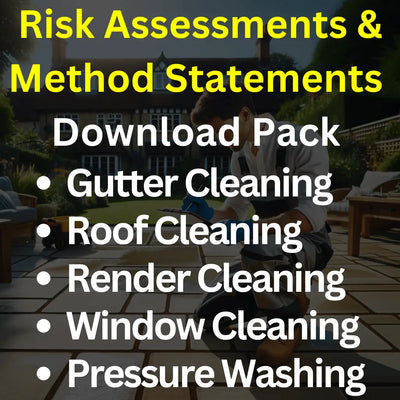
Contractors should have documented procedures covering working at height, chemical handling, public protection, runoff, manual handling and emergency measures. SoftWash UK’s Risk Assessment and Method Statement pack for exterior cleaning can help contractors develop more professional paperwork and site planning.
4. Protect surrounding areas
Identify sensitive plants, ponds, lawns, painted surfaces, metalwork, vehicles, neighbouring property, water butts and drainage routes. Pre-wetting, covering, controlled application and managed rinsing may all be required depending on the chemical and site layout.
5. Remove heavy moss safely
Where moss is thick, manual removal before treatment is often best. Use scrapers matched to the tile profile and avoid damaging laps or coatings. Bag debris where possible rather than allowing large volumes to enter gutters and drains.
6. Apply the treatment at low pressure
Use suitable soft washing equipment designed for controlled application rather than improvised high-pressure systems. Work methodically, avoid overspray and keep within safe weather conditions. Wind can turn a simple job into a liability.
7. Allow correct dwell time
Dwell time is essential. Rushing the process leads to poor results and unnecessary reapplication. Follow product guidance and adjust for temperature, surface porosity and contamination level.
8. Rinse or leave to weather clean as appropriate
Many roof treatments are designed to keep working after application and weather clean over time. Others may require rinsing depending on the chemistry, surface and specification. Always follow product instructions and manage runoff responsibly.
9. Final inspection and client handover
Explain what has been done, what results to expect immediately, what will improve over time, and when maintenance may be needed. This is especially important with softwashing because clients may expect the instant “pressure washed” look unless expectations are set clearly.
Common Mistakes When Cleaning Roof Tiles
Using too much pressure
The most obvious mistake is using excessive pressure close to the tile surface. This can scar tiles, dislodge edges and push water beneath overlaps. A roof may look clean on the day but have hidden damage.
Cleaning against the tile lap
Spraying upwards or sideways can force water where rain would not normally go. This is one of the biggest risks with pressure washing roof tiles.
Skipping the biocidal treatment
Removing moss without treating the remaining spores often leads to faster regrowth. Whether a roof is manually scraped or lightly washed, a suitable treatment is usually needed for longer-term control.
Failing to manage gutters and drains
Moss debris can block gutters, downpipes and gullies quickly. On commercial sites, this can create flooding risks and maintenance complaints after the contractor has left.
Underestimating chemical responsibility
Softwashing is not just “spraying chemical”. Contractors must understand product labels, dilution, PPE, COSHH, storage, transport, runoff, environmental protection and emergency procedures.
Quoting from the ground only
Roof cleaning quotes based only on a quick look from the pavement often miss access issues, fragile areas, valley build-up, rooflights and drainage risks. A better survey leads to a better method and fewer disputes.
Myths About Softwashing and Pressure Washing Roofs
Myth: Pressure washing is always faster and cheaper
It may look faster at first, but when you include access, debris clearance, risk of damage, post-treatment and customer complaints, pressure washing is not always the cheaper option. For contractors, speed without control can be expensive.
Myth: Softwashing is just a chemical shortcut
Professional softwashing requires knowledge. The operator needs to understand surfaces, application rates, dwell time, runoff, PPE, environmental protection and customer expectations. Poor softwashing is just as unprofessional as poor pressure washing.
Myth: A roof must look perfect immediately
Some softwash treatments continue working after application. Lichen and staining may fade over time through weathering. This should be explained before the job begins so the client understands the process.
Myth: All roof tiles can be cleaned the same way
Tile type, age, porosity, pitch, access and condition all affect method choice. A 1990s concrete tile roof is not the same as an older clay tile roof or a brittle slate roof.
Safety and Compliance Notes for UK Contractors
Roof cleaning is a higher-risk exterior cleaning service because it combines height, water, slippery growth, chemical handling and public-facing work. Contractors should take a professional approach to compliance, including:
- Working at Height Regulations considerations.
- COSHH assessment for cleaning products.
- PPE including eye, hand and skin protection as required by the product.
- Safe chemical storage and transport.
- Public and occupant exclusion zones.
- Runoff control and environmental protection.
- Weather assessment, especially wind and frost risk.
- Emergency procedures for spills, exposure or accidents.
Contractors who want to formalise their knowledge should consider structured learning through the SoftWash UK training course, which covers professional method selection, chemical understanding and practical exterior cleaning standards.
Which Method Should Facilities Managers Specify?
Facilities managers and property maintenance professionals should specify roof cleaning based on asset protection, safety and long-term value rather than the lowest headline price. A good specification should ask contractors to provide:
- A written method statement.
- Evidence of insurance for roof cleaning and chemical application.
- A clear access plan.
- Details of cleaning chemicals and safety data sheets.
- Runoff and vegetation protection measures.
- Before-and-after photographic reporting.
- Realistic expectations for immediate and progressive results.
For commercial properties, schools, care homes, retail sites and managed housing, softwashing is often easier to justify because it reduces aggressive surface impact and can be integrated into planned maintenance cycles.
When Serious DIY Users Should Think Twice
Some capable DIY users have the confidence to clean patios or low-level exterior surfaces. Roof tiles are different. The main risk is not only choosing the wrong cleaning method; it is falling from height. A wet, mossy pitched roof is not a safe place to learn by trial and error.
If you are a property owner considering DIY roof cleaning, be cautious with pressure washers, online chemical recipes and ladder-based methods. Consider whether the cost saving is worth the risk of injury, tile damage, water ingress or environmental harm. In many cases, hiring a trained and insured professional is the sensible option.
If you are a contractor moving from pressure washing into roof softwashing, invest time in training and documentation before taking on complex roof projects. Learning the principles properly will help protect clients’ properties and your business reputation.
If this is an area you want to understand properly, you can start by accessing the free SoftWash UK course preview. It includes selected lessons from the full training course and is designed to help contractors see whether professional softwashing training is the right next step.
Frequently Asked Questions
Is softwashing safe for roof tiles?
Softwashing can be safe for many roof tiles when the roof is properly surveyed, the correct treatment is selected, and the product is applied at low pressure by a competent operator. Safety depends on tile condition, access, dilution, dwell time, runoff control and compliance with product instructions.
Can pressure washing damage roof tiles?
Yes. Pressure washing can damage roof tiles if the pressure is too high, the nozzle is too close, the roof is fragile, or water is sprayed against the tile laps. Damage may include surface erosion, cracked tiles, disturbed mortar and water ingress.
Does softwashing remove moss from roof tiles?
Softwashing treats moss and organic growth, but heavy moss is often best removed manually first. A professional roof cleaning process may involve scraping large deposits before applying a softwash or biocidal treatment to deal with remaining growth and spores.
How long does roof softwashing take to work?
Some results may be visible quickly, especially on algae and light staining. Lichen, black staining and remaining organic marks can take days, weeks or longer to fade as the treatment works and the roof weathers naturally. Expectations should be explained before the job starts.
Should roof tiles be sealed after cleaning?
Not always. Sealing is a separate specification and should not be automatically recommended. The roof condition, tile type, breathability, manufacturer guidance and long-term maintenance plan should all be considered before applying any coating or sealant.
Is softwashing better than pressure washing for clay roof tiles?
In many cases, yes. Clay tiles can be brittle and may not tolerate aggressive pressure washing well, especially on older roofs. A careful low-pressure softwash approach is often more appropriate, provided the tiles are compatible with the chosen treatment.
Conclusion: Choose the Method That Protects the Roof, Not Just the One That Looks Fast
When comparing softwashing vs pressure washing roof tiles, the best answer is not simply about which method cleans fastest. It is about which method protects the roof, controls biological growth, manages risk and delivers a professional result.
Pressure washing can create an immediate visual impact, but on roof tiles it carries real risks when used aggressively or without proper assessment. Softwashing, supported by safe manual moss removal where needed, is usually the more suitable method for UK roof tile cleaning because it uses low-pressure application and targets the organic cause of staining and regrowth.
For contractors, the opportunity is clear: clients increasingly want roof cleaning that is safe, documented, compliant and long-lasting. Building your knowledge of softwashing methods, chemicals, equipment and risk management is a better long-term strategy than relying on pressure alone.
SoftWash UK supports exterior cleaning professionals with practical education, professional softwashing chemicals, suitable equipment and training resources. If you are developing roof cleaning services or refining your existing process, visit SoftWash UK to explore the Knowledge Centre, products and training options designed for responsible professional softwashing.