How Professional Training Can Reduce Costly Errors in Exterior Cleaning
Professional training reduces costly errors in exterior cleaning by helping contractors choose the right cleaning method, assess risk properly, apply chemicals safely, protect surfaces, price work accurately and avoid avoidable damage claims. For UK softwashing, roof cleaning, render cleaning, cladding cleaning and general exterior maintenance, many of the most expensive mistakes happen before the trigger is pulled: poor survey work, weak dilution knowledge, unsuitable equipment, inadequate insurance, missing RAMS, or a misunderstanding of how a surface will react.
For exterior cleaning contractors, property maintenance professionals, facilities managers and serious DIY users, training is not just about learning how to clean. It is about learning how to avoid the failures that cost money, time, reputation and sometimes legal action. A cracked window, stained render, damaged plants, overspray on vehicles, ineffective biocide application or an underpriced commercial job can easily wipe out the profit from several successful projects.
At SoftWash UK, we see the same pattern regularly: people often invest in chemicals and equipment before they invest in understanding the process. The most reliable operators usually do the opposite. They build knowledge first, then select the right products, equipment and systems for the type of work they intend to carry out.
Why Training Matters More Than Trial and Error
Trial and error is an expensive way to learn exterior cleaning. It may feel practical, but it often means learning on a customer's property, with real surfaces, real liabilities and real expectations. Professional training shortens that learning curve by putting structure around the work.
A good softwashing or exterior cleaning training programme should help you understand:
- Which surfaces are suitable for softwashing, pressure washing, manual cleaning or specialist treatment.
- How organic growth, atmospheric staining, carbon deposits, rust, oil, algae, lichen and moss differ.
- How to survey a property before quoting.
- How to select chemicals safely and legally.
- How to protect plants, painted surfaces, metals, timber, glass, leadwork and surrounding areas.
- How to write and follow a risk assessment and method statement.
- How to price jobs with enough margin for labour, materials, travel, overhead and risk.
- How to communicate realistic outcomes to customers.
This is especially important in softwashing, where chemical knowledge, dwell time, surface compatibility and environmental control matter just as much as application skill. If you are new to the trade, the SoftWash UK Knowledge Centre article on How Do You Become A Softwash Contractor is a useful starting point for understanding the practical steps involved in entering the industry professionally.
The Most Common Costly Errors Training Helps Prevent
In exterior cleaning, errors often fall into several predictable categories. Some are technical, some are commercial and some are compliance-related. Training helps contractors recognise these risks before they become expensive problems.
| Costly error | Typical cause | How training helps reduce the risk |
|---|---|---|
| Surface damage | Using too much pressure, wrong nozzle, unsuitable chemical or poor dwell time control | Teaches surface identification, method selection and test patch procedures |
| Chemical injury or exposure | Poor PPE, incorrect handling, inadequate COSHH knowledge or unsafe mixing | Builds safe working habits, label awareness, SDS understanding and emergency planning |
| Plant and garden damage | Overspray, runoff, poor pre-wetting or lack of rinse management | Explains protection methods, site control and responsible application |
| Poor cleaning results | Misdiagnosing staining, rushing dwell time or using the wrong solution | Improves diagnosis of biological growth, staining and substrate condition |
| Profit loss | Underquoting, missing access requirements, weak productivity planning | Improves survey process, pricing logic and job planning |
| Insurance issues | Working outside policy terms or failing to document methods | Encourages professional documentation, disclosure and risk management |
Technical Errors: When the Wrong Method Costs More Than the Job Is Worth
One of the biggest benefits of professional training is learning when not to use a particular method. Many cleaning failures happen because the contractor only has one approach. If all you have is high pressure, every surface starts to look pressure-washable. If all you know is softwashing, every stain starts to look organic. Neither approach is professional.
Surface Identification Reduces Damage Claims
Exterior cleaning contractors work on a wide range of materials, including:
- K-render, monocouche and painted render.
- Natural stone, concrete, brick and block paving.
- Clay tiles, concrete roof tiles and slate.
- UPVC, powder-coated aluminium and plastisol-coated cladding.
- Timber decking, fencing and cladding.
- Leadwork, copper, zinc, glass and painted metalwork.
Each surface behaves differently. A method that works well on a concrete yard may damage render. A chemical that is suitable for biological growth on one surface may be unsuitable around sensitive metals or poorly maintained paintwork. Training teaches contractors to look for risk indicators such as failed coatings, hairline cracks, porous materials, oxidised frames, unsealed timber, fragile mortar, loose pointing and previous chemical staining.
Test Patches Are Not Optional on Sensitive Work
On commercial buildings, heritage properties, expensive residential homes and unfamiliar substrates, a controlled test patch is one of the simplest ways to avoid a dispute. It helps confirm compatibility, likely improvement, dwell time and customer expectations.
A professional test patch should be:
- Small enough to control.
- Located in an agreed area.
- Documented with photos.
- Assessed after the appropriate dwell or reaction period.
- Used to confirm the method before full-scale cleaning.
Training encourages this thinking. It moves the operator away from guesswork and towards evidence-based decisions.
Chemical Knowledge Prevents Expensive and Unsafe Mistakes
Softwashing chemicals can be very effective when used correctly, but they must be selected, handled, stored and applied responsibly. The aim is not to use the strongest possible product. The aim is to use the appropriate product, in the safest practical way, for the surface and contamination being treated.
For example, professional contractors need to understand the difference between cleaning organic growth with a suitable softwash solution, treating residual biocidal growth, using a surfactant to improve wetting, and selecting specialist products for non-organic staining such as rust, oil or tannin movement. SoftWash UK supplies a range of professional soft wash chemicals, but the product choice should always follow a correct diagnosis of the surface and staining.
Why Safety Data Sheets and Labels Matter
One mistake we still see in the industry is treating chemical instructions as optional. They are not. Contractors should understand product labels, Safety Data Sheets, storage requirements, PPE guidance, first aid measures and environmental precautions.
Access to up-to-date documentation matters when training staff, completing site files or responding to customer and facilities management requirements. SoftWash UK provides Softwash SDS Sheets to help operators maintain the documentation needed for responsible chemical use.
Common Chemical Mistakes Training Helps Avoid
- Mixing products without understanding compatibility or manufacturer guidance.
- Using a stronger solution to compensate for poor technique.
- Failing to account for wind drift and overspray.
- Allowing chemical runoff to enter sensitive planted areas or uncontrolled drainage routes.
- Applying product to hot, dry or unsuitable surfaces without adjustment to method.
- Failing to rinse or neutralise where the product instructions require it.
- Confusing organic growth with mineral staining, rust, oil or oxidation.
Training does not remove the need to read labels and follow site-specific procedures. It gives contractors the understanding needed to interpret those requirements correctly.
Risk Assessment: The Difference Between Professional and Casual Cleaning
A proper risk assessment is not paperwork for the sake of paperwork. It is a practical tool that helps you think through what could go wrong and how to prevent it. For exterior cleaning, that includes chemical handling, access, working at height, weather, public safety, slips, fragile surfaces, electrical hazards, water management and environmental protection.
The SoftWash UK Knowledge Centre guide on softwash risk assessment explains why risk assessments are a core part of professional softwashing work, particularly when chemicals, public areas or commercial sites are involved.
What a Good Exterior Cleaning Risk Assessment Should Consider
- Who may be harmed: operatives, occupants, pedestrians, pets, neighbours or other contractors.
- What hazards exist: chemicals, access equipment, slippery surfaces, traffic, glass, fragile roofing, electrical fixtures and drainage.
- How risk will be controlled: barriers, signage, exclusion zones, PPE, method selection and supervision.
- What emergency procedures are in place: spill response, eye wash, first aid, water access and communication.
- What documentation is required: RAMS, COSHH assessments, SDS, insurance evidence and training records.
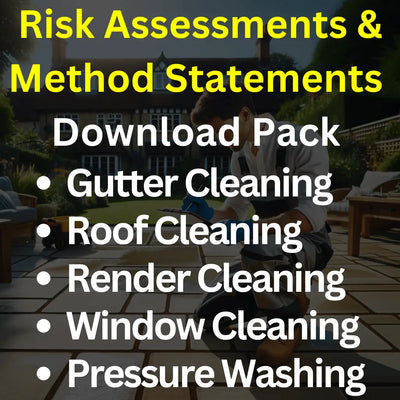
For contractors who need practical documentation support, the Risk Assessment and Method Statement RAMS Pack for Exterior Cleaning can help provide a structured starting point. It should still be adapted to the actual site and work being carried out, rather than copied blindly.
Training Helps Prevent Quoting and Business Mistakes
Not every costly error happens on the wall, roof or driveway. Some happen at the quote stage. Underpricing is one of the fastest ways for a contractor to look busy while losing money.
A trained contractor is more likely to identify the hidden costs in a job, such as:
- Difficult access or long hose runs.
- Extra plant protection and rinsing time.
- Traffic or pedestrian management.
- Out-of-hours working on commercial sites.
- Additional dwell time or repeat application requirements.
- Specialist stain treatment rather than standard cleaning.
- Wastewater control and environmental considerations.
- Travel, setup, breakdown and documentation time.
Facilities managers and property maintenance professionals also benefit from this knowledge. It helps them evaluate contractor proposals more intelligently. A cheap quote with no RAMS, no insurance detail and no clear method statement may not be cheaper if it leads to damage, disruption or compliance problems.
Example: The Underpriced Render Clean
A common real-world example is a contractor quoting a large rendered property from photos alone. On arrival, they discover delicate planting against the elevations, oxidised aluminium trims, poor water access, algae tucked under sill details and a public footpath near the working area. The original quote allowed one day. The job needs two operatives, more sheeting, controlled application, longer setup and careful rinsing. Profit disappears before lunch.
Training encourages contractors to survey properly, ask the right questions and build a quote around risk as well as square metres. The SoftWash UK softwashing training and business hub contains further educational material for contractors who want to improve both technical standards and commercial decision-making.
Equipment Errors: Buying the Wrong Kit or Using It Incorrectly
Another expensive mistake is buying equipment before understanding the work. Some new contractors overspend on systems they do not yet need. Others start with equipment that cannot apply products accurately, reach safely or deliver consistent results.
Professional training helps you match equipment to the work, including:
- Low-pressure softwash application systems.
- Water-fed pole systems and softwash nozzles.
- Chemical-resistant hose, fittings and pumps.
- Controlled dosing or injection systems.
- PPE, spill kits, signage and plant protection equipment.
- Access equipment and work-at-height planning.
SoftWash UK supplies professional soft washing equipment, but the right setup depends on the type of work you plan to complete. A domestic render cleaning setup may look very different from a commercial cladding maintenance system or a roof treatment workflow.
A Practical Step-by-Step Approach Training Instils
Professional training gives contractors a repeatable process. That consistency is what reduces avoidable mistakes. A practical exterior cleaning workflow may look like this:
- Initial enquiry: Identify the surface, location, access, staining type and customer expectations.
- Desktop review: Check photos, maps, access limitations and any obvious risks before visiting.
- Site survey: Inspect surface condition, drainage, planting, power points, neighbouring property and public exposure.
- Method selection: Decide whether softwashing, pressure washing, steam, manual cleaning or specialist treatment is appropriate.
- Test patch: Carry out a controlled test where surface sensitivity or outcome uncertainty exists.
- Quote accurately: Include labour, materials, access, protection, travel, documentation and risk allowance.
- Prepare RAMS and COSHH: Make documentation specific to the site and task.
- Set up safely: Establish exclusion zones, signage, PPE, water access, plant protection and emergency controls.
- Apply methodically: Work in controlled sections and adjust technique based on conditions.
- Check results: Inspect before leaving, take photos and explain any expected ongoing biocidal action or weathering.
- Record the job: Keep notes, photos, product details and any customer sign-off for future reference.
This type of process is especially valuable when training employees. It means standards do not depend solely on one experienced person being present on every site.
Insurance and Compliance: Training Helps You Ask Better Questions
Insurance is often misunderstood in exterior cleaning. Having public liability insurance does not automatically mean every softwashing, roof cleaning, chemical application or work-at-height activity is covered. Contractors must understand their policy terms, exclusions, height limits, chemical use wording and any requirements for training or documentation.
The SoftWash UK Knowledge Centre guide on softwash contractor insurance is a useful read for contractors who want to understand what cover may be relevant before taking on higher-risk work.
Training also supports compliance by helping contractors understand where documentation fits into the job. On commercial and facilities management sites, you may be asked for RAMS, COSHH assessments, SDS, proof of competence, insurance documents and sometimes evidence of previous experience. Being able to provide these professionally can be the difference between winning and losing a contract.
Professional Training Versus Learning From Videos Alone
Online videos can be useful, but they rarely give the full picture. Many show the satisfying part of the clean without explaining the survey, risk assessment, product choice, surface limitations, insurance considerations or what happened after the camera stopped recording.
| Learning method | Benefits | Limitations |
|---|---|---|
| Free online videos | Easy to access, useful for seeing techniques and equipment in use | Often lacks context, safety detail, UK compliance guidance and structured progression |
| Supplier instructions | Important for product-specific use, safety and compatibility | Does not replace wider training on surveying, quoting, risk control and method choice |
| Professional training | Structured learning, practical standards, safety focus and business application | Requires time and investment, but reduces costly avoidable mistakes |
| On-site experience | Builds confidence and judgement over time | Can be expensive if gained without supervision or proper knowledge |
For contractors wanting recognised development, SoftWash UK offers CPD certified softwash training, which supports a more structured approach to professional learning and industry competence.
Common Myths About Training in Exterior Cleaning
Myth 1: “I Can Learn Everything on the Job”
Experience matters, but unstructured experience can include expensive lessons. Training helps you understand what to look for before something goes wrong. It also helps you learn from other people's mistakes rather than repeating them yourself.
Myth 2: “Training Is Only for Beginners”
Experienced contractors often benefit from training because they already have real site experience to connect with the learning. They tend to ask better questions and identify improvements in quoting, documentation, staff training and process control.
Myth 3: “If a Chemical Works, It Must Be the Right Choice”
A product can clean a surface and still be unsuitable for that setting if it creates unnecessary risk to metals, plants, coatings, drainage or the public. Professional judgement is about choosing the safest effective method, not just achieving a visible result.
Myth 4: “RAMS Are Only Needed for Big Commercial Jobs”
Smaller domestic jobs can still involve chemicals, slippery surfaces, fragile materials, pets, neighbours, children and public access. The level of documentation may vary, but the risk assessment mindset should be present on every job.
How Facilities Managers Can Use Training Standards When Choosing Contractors
Facilities managers and property maintenance teams are often responsible for selecting exterior cleaning contractors. Understanding training standards helps them ask better procurement questions and reduce risk across managed properties.
Before appointing a contractor, ask:
- What training have operatives completed?
- Can the contractor explain why their chosen method is suitable?
- Will they provide site-specific RAMS and COSHH information?
- Do they hold appropriate insurance for the exact type of work?
- How will they protect pedestrians, vehicles, planting and adjacent properties?
- What products will be used, and are SDS documents available?
- How will results be documented and reported?
These questions help separate professional contractors from operators who are relying on guesswork. They also protect the facilities manager from avoidable disruption and complaints.
Making Training Part of a Professional Exterior Cleaning System
The best contractors treat training as part of a wider system, not a one-off event. That system includes suitable chemicals, reliable equipment, clear documentation, ongoing learning and honest job assessment.
A practical professional system should include:
- Documented survey and quoting procedures.
- Clear method statements for common types of work.
- COSHH assessments and product SDS access.
- Staff induction and refresher training.
- Equipment maintenance checks.
- Customer communication templates.
- Photo records before, during and after work.
- A process for reviewing near misses, complaints and difficult jobs.
Contractors who build systems like this are usually more consistent, more profitable and better prepared for larger clients. Serious DIY users can also learn from this approach by planning properly, reading product guidance and avoiding unnecessary risk on their own property.
If this is an area you want to understand properly, you can start by accessing the free SoftWash UK course preview. It includes selected lessons from the full training course and is designed to help contractors see whether professional softwashing training is the right next step.
When Is Professional Training Worth the Investment?
Professional training is worth considering if you are:
- Starting an exterior cleaning or softwashing business.
- Adding softwashing to an existing pressure washing, window cleaning or property maintenance service.
- Taking on commercial sites or facilities management work.
- Training employees or subcontractors.
- Using professional chemicals and application equipment.
- Working on render, roofs, cladding or sensitive surfaces.
- Unsure how to price, document or manage higher-risk jobs.
The cost of training should be viewed against the cost of one serious error. A damaged render elevation, chemical claim, uninsured incident, failed commercial job or repeated underquoting can cost far more than professional education. The SoftWash UK Soft Wash Training Course is designed to help contractors build practical knowledge around safe, responsible and commercially sound softwashing.
Frequently Asked Questions
How does professional training reduce exterior cleaning mistakes?
Professional training reduces mistakes by giving contractors a structured process for surveying, risk assessment, method selection, chemical handling, equipment use, plant protection, pricing and documentation. It helps operators identify risks before they cause damage or financial loss.
Is softwashing training necessary if I already pressure wash?
Yes, it is strongly recommended. Pressure washing experience is useful, but softwashing involves different skills, including chemical application, dwell time control, surface compatibility, COSHH awareness and environmental protection. The two methods often complement each other, but they are not the same.
Can training help me win more commercial exterior cleaning work?
Training can help because commercial clients often expect clear method statements, risk assessments, insurance details, SDS documents and evidence of competence. A trained contractor is usually better able to present a professional proposal and explain why their method is suitable.
Does professional training replace insurance?
No. Training does not replace insurance. However, it can support safer working practices and better documentation. Contractors should still ensure they have appropriate public liability, employer’s liability where required, treatment risk cover if applicable, and cover for the specific activities they carry out.
What is the most expensive mistake new softwash contractors make?
One of the most expensive mistakes is taking on work without properly understanding the surface, chemistry, access requirements and risks. This often leads to underquoting, poor results, plant damage, surface damage or disputes with customers.
Should serious DIY users consider training?
Serious DIY users who plan to use professional-grade softwashing products or clean sensitive surfaces can benefit from structured education. Even if they do not intend to trade commercially, understanding safety, PPE, product labels, surface compatibility and environmental precautions is important.
Conclusion: Training Is a Cost-Control Tool, Not Just a Certificate
Professional training is one of the most effective ways to reduce costly errors in exterior cleaning. It helps contractors avoid surface damage, chemical misuse, weak quoting, poor documentation, unsafe working practices and preventable complaints. For facilities managers, it provides a benchmark for choosing competent contractors. For serious DIY users, it encourages safer, more informed decision-making.
The exterior cleaning industry rewards practical knowledge. The more you understand about surfaces, staining, chemicals, equipment, risk and customer expectations, the less you rely on guesswork. That reduces mistakes and improves profitability, safety and professional reputation.
SoftWash UK supports UK exterior cleaning professionals with specialist chemicals, equipment, training and educational resources. If you want to develop a more professional, lower-risk approach to softwashing, explore the SoftWash UK Knowledge Centre, review suitable products and equipment, and consider structured training before taking on work where mistakes could prove expensive.